Easy objects to start with
|
After all that theory lets look at something. Before that, we need to cover one more bit of theory. Because the Earth is tilted, the day length varies during the year (the amount depends on latitude). In the summer the nights are short and it doesn't get really dark except for a few hours in the early morning (midnight until 2:00 a.m. in June). So Astronomy tends to be a winter hobby. It is cold in winter, so you need to wrap up warm. You also need time to let your eyes adjust to the dark. If you need light (to read star charts) then you should use a red head torch (this will affect your dark adaption less). It is also advisable to use a tripod. It is very difficult to hold a telescope steady and even with binoculars your arms get tired after a while. You can get special adaptors for mounting binoculars on a tripod. Moon The moon being easy to find is perhaps the one to start with. You might think the best time to view the moon is at full moon. However unless you have a means to add a neutral density filter to your eye-piece, you might find the moon too bright unless using binoculars with small object lenses. After observing the moon you should give your eyes time to reacquire dark adaption before moving around, particularly if there are obstacles that could trip you up. The best size of object lens (aperture) for astronomy is 40mm or bigger if possible. The new moon or half moon is not as bright and gives better views. The best part of the moon to observe is along the terminator line, the part between the lit part and the part in shadow. The sun's angle is very low in this twilight zone, just as the sun is low in our sky around earthly twilight. And along this terminator, lunar features cast long shadows and show good relief. The moon orbits the Earth in 28 days, a lunar cycle. When it is near the Sun it displays a crescent shape and is seen in the evening or morning depending on whether it sets just after or rises just before the Sun. When it is on the same side of the Earth as the Sun it is seen during the day. When it is on the opposite side of the Earth to the Sun, it is seen during the night. Since we wish to observe it in the evening or early night, rather than late night or early morning, it will only be in a suitable position for about a week. The full moon can be observed during the day as it is still visible and because are pupils will be stopped down due to the daylight, so the moon will not be too bright. It will look flat though. Meteors There are two sorts of meteors; periodic and sporadic. The periodic ones occur at predictable times and are related to comets (debris from the tails). The periodic ones are the ones to go for as they are predictable and occur as showers. They can be seen anywhere in the sky, but they all appear to originate from the same (for a given shower) point in the sky called the radiant. The location of this radiant within a constellation gives the name of the meteor shower; The Leonids, the Orionids, the Geminids, etc.. You can find a list of the meteor showers on Wikipedia. Not all of these are worth hunting for unless you specialise in meteor hunting. The best, or most famous, of these are the Perseids which occur around 12 August each year. However every 30 years or so the Leonids outdo them, the next storm should be about 2033. The sporadic meteors are not associated with comet paths but are the same, a piece of space debris or an asteroid entering and burning up in the Earth's atmosphere. Meteor observing is different to normal observing. Because they are ephemeral, there is not time to align them in binoculars, let alone a telescope, so the Mark 1 eyeball is the optical instrument of choice. Also, since you don't know when they will occur, you have to wait, so you will need a seat; a deck chair is ideal. Being sedentary you will need to wrap up even warmer than usual. Set up your deck chair facing the radiant, but don't concentrate on it, you need to use your peripheral vision, which fortunately is very sensitive to movement. 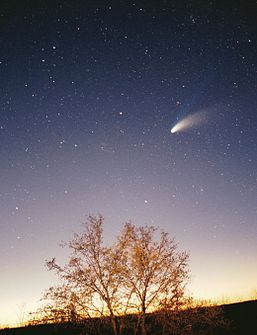
Comets Comets are infrequent visitors and like eclipses, you have to wait for them to come along. A comet is a body in the solar system like an asteroid, but is not dense and solid. Instead it is composed of ice and other material loosely bound together. As it approaches the sun it develops a coma and sometimes a tail. This is what differentiates comets from asteroids. Having tails, illustrations give the impression that they are rushing across the sky, however although they do move slowly relative to the stars from day to day, they appear to hang in the sky which is strange when you observe your first comet. Artificial Satellites 
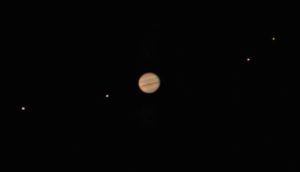
Fortunately there are other, if not so bright, artificial satellites to observe. Like iridium flares though, you do need to know where to look. There are various web sites available to predict passes but the best one is probably the Munich based Heavens above. You need to input your location in latitude and longitude (you can get these from Google maps, or you can look your nearest town up in their database) and it will then give you masses of astronomical data relevant to your observing position. The brightest satellite is the International Space Station, so this is the one to start with. It is an easy naked eye object on overhead passes and a binocular object on lower altitude passes. In a powerful telescope some detail can be made out. Because of its orbit, passes are always west to east. Heavens Above gives predictions for many different satellites, some of which are in North/South orbits, as well as providing a web based planetarium program giving the planets and stars. Planets These appear bigger than stars when magnified because they are nearer, although stars generally are far bigger. Stars remain a point of light even when large magnifications are applied 1 because they are so distant. With reasonable magnification planets are discernable as disks. With large magnification some features can be made out on some planets.
Mars is striking because of its colour (if you are not colour blind) and Venus because phases can be observed. Mercury is exiting as it is difficult to find. Being so close to the Sun it is always observed near the Sun in the bright evening sky. This makes it hard to pick out unless you happen to catch it with your fovea (the central part of the visual field). Once you have spotted it, it is easy, and is surprisingly bright. You will need a planetarium program to tell you when these can be observed and where to find them, (a good one will also tell how far away they are so you can find the best time to observe, when they are closest). If you become good at observing planets then try observing over several nights and plotting the movement against the stellar background. Or observing all 5 of the inner most planets (excluding Earth). Uranus and Neptune are more difficult and will require telescopes because of their distance. Because the planets, including Earth, have elliptical orbits and different periods their distance from the Earth varies, they are more easily observed when closest to Earth. This also gives rise to apparent retrograde motion when the planets appear to double back on themselves relative to the background stars. Deep Sky Objects
The next easy object is Orion. You might have already looked at Orion in learning the constellations or as a means to find the Pleiades. However, Orion includes another famous Messier object, the Orion Nebula. This can be seen with the naked eye as the middle one of the three stars that make up his sword. In binoculars it appears as a fuzzy patch and in a telescope you might see some detail, depending on your magnification. Orion also contains two very bright stars. Rigel a blue star and Beltegeuse a red Giant. It is thought that Beltegeuse will go supernova in the future, though it is not known when.
Other easier objects to try
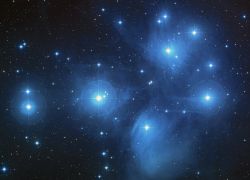
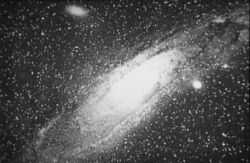
Some of the easier ones are given in the following table. You will need to use your planetarium program to help locate them, or look them up on the web for how to find them.
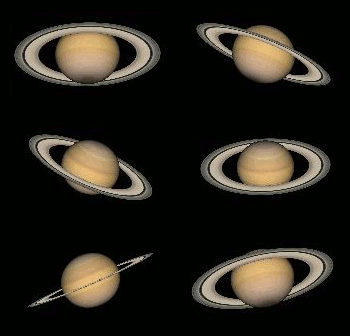
Albireo is not a Messier object. It is a double star in our own galaxy, but it is as difficult as the easy Messier objects, so has been placed in this section. It is also worth looking at, as the two stars are contrasting colours. (next) Footnote 1. Bright stars can appear as large disks in long exposure photographs. This is not because the star has been magnified to a disk, but because the star appears so bright due to the long exposure that the image has spread. This happens both in emulsions and digital sensors. Footnote 2. Originally, based on observation from Earth, it was thought that Saturn was the only planet with a ring system. Since the space probes, in particular the orbiters, we now know that other planets have ring systems, but less pronounced and so not directly observable from Earth. Footnote 3. A dark site is one without light pollution where fainter objects can be observed. True dark sites are in the middle of oceans or the Scottish Highlands, where there are no towns or main roads with their sodium lighting to light up the sky. Reasonable approximations can be found in the countryside away from large towns. You can find the best place near you using this map. The colour scale is defined here. Anything from green upwards is OK for normal viewing, but for faint objects you will need the darkest site you can find. You can see how far away from land you have to be to get true dark skies. There has been pressure to reduce light pollution for some time. More progress is being made now with the green movement and the need to reduce energy consumption. Footnote 4. Averted vision is to look slightly to the side of the object. The aim is to observe with the rim of your macula where there are more rods, rather than the central fovea where there are more cones. You do not want to use your peripheral vision, that is less sensitive to detail, but very sensitive to motion which is what you use in comet watching. It takes practice to attend to various regions of vision. (next) |
[ top ]